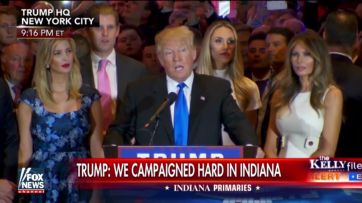
Politico reports that candidate Ted Cruz has officially dropped out of the presidential race, according to his campaign manager Jeff Roe, leaving Donald Trump as the only candidate capable of clinching the nomination.
A string of massive losses in the Northeast and a serious defeat in Indiana combined to knock him out of the race. John Kasich still pledges to stay in the race until a candidate reaches 1,237 bound delegates.
Politico describes Cruz's campaign efforts:
From the start, Cruz has premised his candidacy on the idea that 2016 would be an election driven by resentment toward the established GOP order. It was a strategy that looked prescient as Cruz steadily rose in the polls throughout 2015 and broke into the top tier in Iowa in early 2016.
But what Cruz did not expect — what no one expected — is that he would be outmatched and outstripped in outsider anger by Trump. Cruz had maintained a fragile truce with Trump all of last year, but by the time he turned on the front-runner, the Manhattan businessman had already captured the voters Cruz was hoping would fuel his candidacy.
Cruz lost Indiana after pulling out all the stops: he struck a nonaggression pact with John Kasich. He bought TV ads. His supportive super PACs bought TV ads. He blitzed the Sunday shows. He barnstormed the state on a bus tour. He got the governor’s endorsement. He even named his running mate.
Losing despite all that represented the final nail in the coffin of Cruz’s months-long claim that conservatives were coalescing around his insurgent candidacy.
In early 2016, it had appeared that Cruz had executed masterfully his plan to consolidate conservatives and emerge as Trump’s main rival. In Iowa, he drove Govs. Rick Perry, Bobby Jindal and Scott Walker out of the race before the caucuses — and then crushed the two reigning winners, Mike Huckabee and Rick Santorum, on caucus day.
Even as he exited the race, Cruz had far surpassed most expectations in 2016, particularly in fundraising, as he tapped both big donors and an army of small ones as he became one of the race’s best-financed candidates. His constellation of super PACs raised the second most to Jeb Bush among Republicans last year. And ahead of super Tuesday, his campaign bragged about more than 200,000 volunteers nationwide.
Politico concludes that Cruz, as a 45-year-old only halfway through his first term in the Senate, has laid a foundation for a future candidacy. But that will depend, of course, on whether there is a future for the Republican party itself.