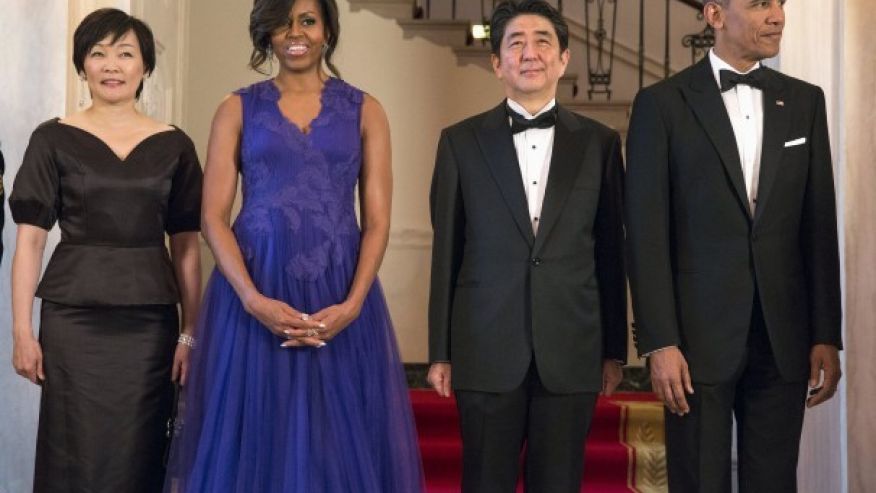
Fashion critic for The Washington Post Robin Givhan read plenty into the fact the first lady Michelle Obama wore a Japanese designer dress to the state dinner hosting Japan's Prime Minister Shinzo Abe and wife, Akie.
"It was a party dress -- pretty, polite and resolutely traditional," Givhan writes. "It was also a beautiful example of fashion diplomacy."
Givhan states that selecting a gown is "a matter of sartorial politics, cultural exchange and U.S. Chamber of Commerce-style marketing." She continues in hopes that one day a man will be in the role and take fashion just as seriously:
Like the inaugural gown, a state dinner dress is a symbol. The first lady, on this night, stands in for the warmth and humanity of the American people. She gives no formal toast. She is not expected to talk policy or politics. She is the gracious hostess, the charming dinner companion — uncomplicated proof of our goodwill.
Her role is, perhaps, neither modern nor politically correct. It is wholly situated in the stereotypes of “the better half” and “the gentler sex.” And perhaps, the days are numbered for a role burdened with such cliches. But even if some day soon there is a gentleman standing in this position, a man whose tuxedo will carry significant cultural freight, there always will be a need — a desire — for the civility that is represented by the formality and pomp of the evening.
But one line Givhan inserted into her piece may be most revealing of the reality of this first lady, even if unintentional:
Getting dressed up doesn’t change a person’s fundamental nature.
Photo source: Washington Post