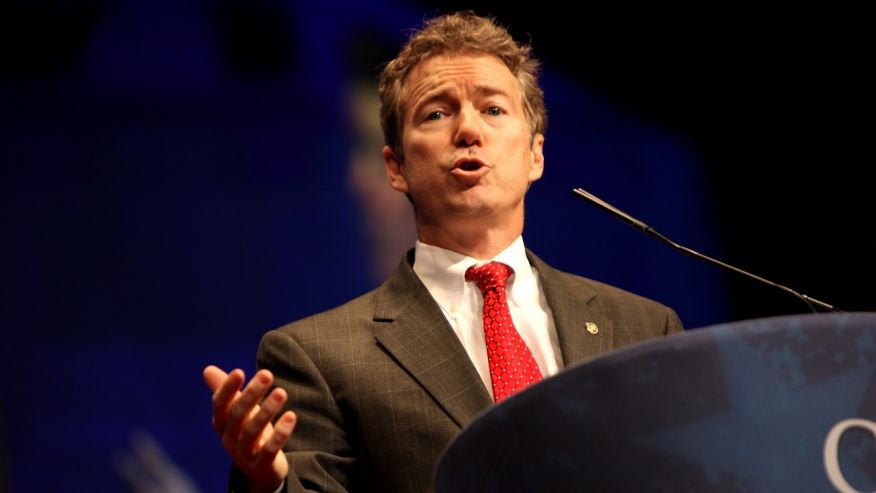
In an opinion piece published in Time Sunday, Republican presidential candidate Sen. Rand Paul argues that it's time for the government to "get out of the marriage business altogether."
Paul begins by making clear that he "disagrees" with the Supreme Court's 5-4 ruling Friday that redefined marriage, but the Senator also states that he believes "all Americans have the right to contract." The real problem, he maintains, is the federal government unconstitutionally inserting itself into what should be a local issue:
The Constitution is silent on the question of marriage because marriage has always been a local issue. Our founding fathers went to the local courthouse to be married, not to Washington, D.C.
I’ve often said I don’t want my guns or my marriage registered in Washington.
In summarizing the arguments in favor of the Supreme Court decision, Paul notes the inconsistency of the left's concern for citizens' rights:
Do consenting adults have a right to contract with other consenting adults? Supporters of the Supreme Court’s decision argue yes but they argue no when it comes to economic liberties, like contracts regarding wages.
It seems some rights are more equal than others.
Acknowledging that marriage is "more than just a simply contract," Paul warns of the "dangers" of the federal government's increased meddling in issues involving sincerely held religious beliefs. Against further government actions against Americans' religious freedom, Paul states that he "will stand ready" to fight for liberty:
I acknowledge the right to contract in all economic and personal spheres, but that doesn’t mean there isn’t a danger that a government that involves itself in every nook and cranny of our lives won’t now enforce definitions that conflict with sincerely felt religious convictions of others.
Some have argued that the Supreme Court’s ruling will now involve the police power of the state in churches, church schools, church hospitals.
This may well become the next step, and I for one will stand ready to resist any intrusion of government into the religious sphere.
Agreeing with Justice Clarence Thomas' statement in his dissent that the American understanding of liberty is "individual freedom from governmental action," not "a right to a particular governmental entitlement," Paul says that it's time to take a hard look at government's involvement in marriage:
Since government has been involved in marriage, they have done what they always do — taxed it, regulated it, and now redefined it. It is hard to argue that government’s involvement in marriage has made it better, a fact also not surprising to those who believe government does little right. [...]
What does government convey along with marriage, and should it do so? Should the government care, or allocate any benefits based on marital status?
And can the government do its main job in the aftermath of this ruling — the protection of liberty, particularly religious liberty and free speech?
Though Paul says, "We shall see," he clearly conveys a deep skepticism about the government's ability to restrain itself from further abuses of personal liberty. "Perhaps it is time to be more careful what we ask government to do, and where we allow it to become part of our lives," he says.
He ends by noting that the Constitution was the first "where rights came from our creator and therefore could not be taken away by government." The government, he writes, "was instituted to protect them," and it's time we "turn back" to embrace that understanding of the role of government. "To protect our rights we must understand who granted them and who can help us restore them," he concludes.